
Two-Prong Outlets in Older Topeka Homes: Your Options
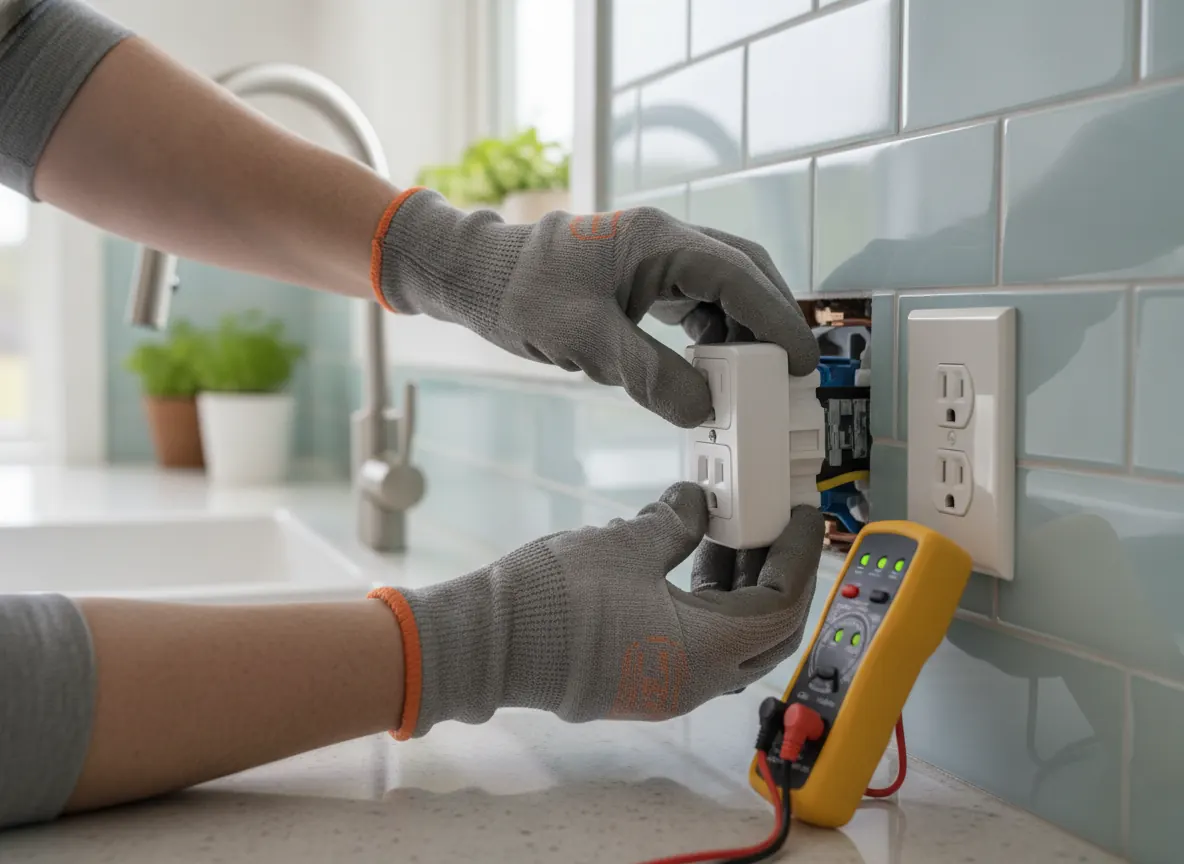
Short answer: a two-prong outlet has no equipment ground. That is normal in many older homes, and it isn't a hazard on its own for lamps and other two-prong devices. The problem comes when you need to plug in three-prong equipment. Your options are to leave it, protect it with a GFCI labeled "No Equipment Ground," have a licensed electrician add a ground, or rewire the circuit. What you shouldn't do is swap in a three-prong outlet with nothing connected to the ground screw, or rely on a cheater adapter.
Why so many Topeka homes still have them
Topeka's housing is older than most. In the Census Bureau's ACS 2020–2024 5-year estimates, the median year built for Topeka homes is 1967, 67.5% were built before 1980 and 22.6% before 1950. Houses from those eras were often wired without an equipment ground at the outlets, or with older cable that had no ground wire.
That is especially common in older neighborhoods. Potwin Place dates to the 1880s, and a city survey found most College Hill homes were built between 1910 and 1929. Historic Holliday Park, Westboro, Old Town and parts of North Topeka have plenty of early houses too. Many have been updated over the years, some only partly, so two- and three-prong outlets often sit side by side. The only way to know what's behind the wall is to have it checked. If you suspect knob-and-tube wiring, read our knob-and-tube guide.
How to tell what you have
- Two slots, no round hole: an ungrounded outlet.
- Three-prong outlet in an older house: it may or may not be grounded. An inexpensive plug-in tester can show "open ground."
- A "bootleg ground": a jumper from the neutral to the ground screw can fool a plug-in tester. Only opening the box shows it, and it should be corrected.
- A GFCI with a "No Equipment Ground" sticker: someone already used the GFCI option.
Turn the breaker off before removing any cover plate, or leave the checking to a licensed electrician.
Your options, compared
| Option | What it does | Good for | Limits |
|---|---|---|---|
| Leave it as a two-prong outlet | Keeps it as is, or replaces it with a new two-prong outlet | Lamps, clocks and two-prong devices | No ground for three-prong equipment |
| GFCI outlet labeled "No Equipment Ground" | Adds shock protection and accepts three-prong plugs | Kitchens, baths, bedrooms where a ground can't be added easily | No equipment ground for surge strips or electronics that rely on one |
| GFCI breaker for the whole circuit | Protects every outlet on that circuit from the panel | Several ungrounded outlets on one circuit | Panel must accept a listed GFCI breaker |
| Add an equipment grounding conductor | Runs a ground wire back to the panel or an approved point | Rooms with computers, a home office, a TV wall | Opens walls or needs a route through the attic or basement |
| Rewire the circuit | New grounded cable from the panel | Old or damaged wiring, remodels | More cost and wall repair |
The National Electrical Code allows a GFCI to replace an ungrounded two-prong receptacle, with the outlet marked "No Equipment Ground" and "GFCI Protected." Topeka enforces the 2023 NEC; ask your contractor how it applies to your house. The outlets and GFCI page covers installation in more detail, and the rewiring older homes page covers bigger jobs.
What it may cost
| Job | Typical range | Source |
|---|---|---|
| Service call (often covers the first hour) | $100–$200 · service visit $176–$327 | HomeGuide · Fixr |
| GFCI outlet | $130–$300 (avg ≈ $210) | Angi, 2026 |
| Whole-house rewiring | about $6–$10 per sq ft | 2026 cost guides |
| City of Topeka residential electrical (trade) permit | $55 | City of Topeka Resolution 9755, 2026 |
Adding a ground is priced per circuit and depends on access. Ask for a written, itemized quote. For more ranges, see the Topeka electrician cost guide.
Cheater plugs and other shortcuts
A three-to-two adapter only gives you a ground if its tab is screwed to a grounded box, which older boxes often aren't. Snapping off the ground pin on a plug, or putting a three-prong outlet on an ungrounded circuit without a GFCI and label, gives the look of a ground with none behind it. Surge strips and some electronics depend on a real ground to work as designed.
Permits
Topeka enforces the 2023 National Electrical Code. Most new wiring, circuits, panels and service changes need a city permit; your contractor normally pulls it. Topeka's 2026 residential trade permit fee is $55, and work started without a permit costs a contractor $500 extra.
Swapping a like-for-like outlet may be minor work, but adding grounds, new circuits or rewiring generally isn't. Topeka issues homeowner trade permits; ask Development Services whether your job qualifies.
Renters and landlords
Kansas law requires landlords to keep supplied electrical systems in good and safe working order (K.S.A. 58-2553). Report problems in writing. Renters near Washburn and in older central Topeka rentals often find two-prong outlets; ask the landlord rather than using adapters or swapping outlets yourself. Landlords can see the rental electrical inspection page. This is general information, not legal advice.
Selling or insuring an older home
Home inspectors usually note ungrounded outlets, and some insurers ask about older wiring. A written report from a licensed electrician on what's grounded, what's GFCI protected and what was updated can help in either conversation.
Questions to ask the electrician
- What is your City of Topeka license number?
- Can you send insurance and workers' comp certificates?
- Which outlets can be grounded, and which are better as GFCI with labels?
- Can I have a written, itemized quote by circuit?
- Is there a trip or diagnostic fee?
- Who pulls the permit, if one is needed?
Kansas has no statewide electrician license; cities and counties license electricians (K.S.A. 12-1525). In Topeka, ask for the contractor's City of Topeka license and confirm it with Development Services (785-368-3905); the city also posts a licensed-contractor list. In Lawrence, check with Lawrence Building Safety (785-832-7700). Outside city limits in Shawnee County, Land Use & Development (785-251-5410) handles permits. Ask for certificates of liability insurance and workers' comp.
About this site: Topeka Electricians is a free quote-referral service, not an electrician or electrical contractor. It holds no electrical license and does not perform electrical work. You describe the job once, and independent electrical contractors serving Topeka, KS and nearby towns can reply with quotes on their own schedules. Some companies may pay to receive requests or calls. Request free quotes.
Frequently asked questions
Are two-prong outlets safe?
On their own, two-prong outlets are a normal part of many older homes and work for two-prong devices. The concern is using three-prong equipment without a ground. A GFCI, an added ground or rewiring are the usual fixes.
Can I replace a two-prong outlet with a three-prong outlet?
Only if a ground is present, or if the new outlet is GFCI protected and labeled "No Equipment Ground" as the National Electrical Code allows. A three-prong outlet with nothing on the ground screw is not a fix.
How much does it cost to replace two-prong outlets?
National cost guides put a GFCI outlet at about $130–$300 each installed (Angi, 2026). Adding a ground wire is priced per circuit and depends on wall and attic access, so ask for a written, itemized quote.
Does my landlord have to fix ungrounded outlets?
Kansas law requires landlords to keep supplied electrical systems in good and safe working order (K.S.A. 58-2553). Report problems to the landlord in writing. This is general information, not legal advice.