
Knob-and-Tube Wiring in Topeka's Older Neighborhoods
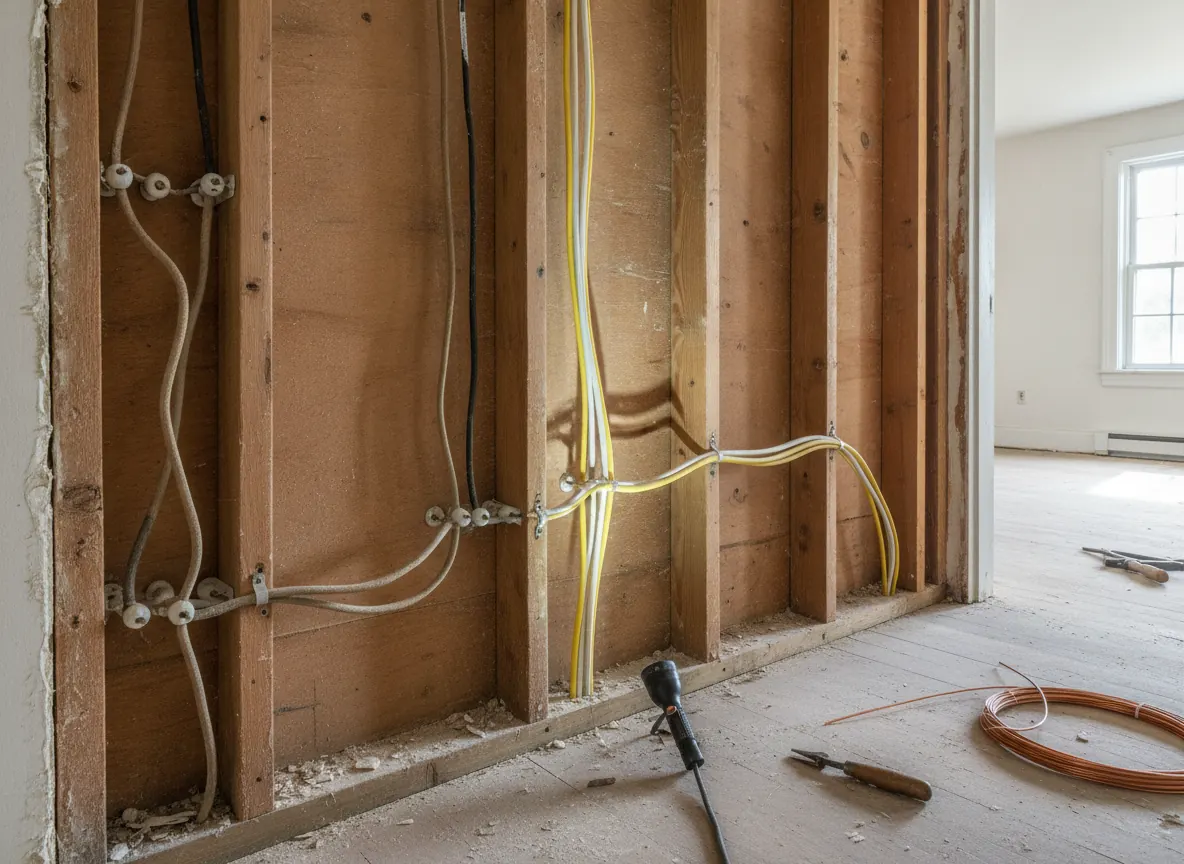
Topeka, KS has a large stock of older homes. About 16% of the city's homes were built in 1939 or earlier (Census ACS 2020–2024 5-year estimates), and they are clustered in neighborhoods like Potwin, College Hill, Historic Holliday Park, Westboro, Old Town and Collins Park. Some of those houses were first wired with knob-and-tube. Many have since been partly or fully rewired, so a house's age alone does not tell you what is in the walls. This guide explains how to recognize knob-and-tube, why insurers ask about it, and the usual options.
Do not handle it. Knob-and-tube that is still in use is live, and old insulation can crumble when touched. Look, take photos from a distance and leave the wiring alone. If you see scorching, smell burning or find damaged wire, turn off that circuit at the panel if you safely can and call an electrician. For smoke or fire, call 911.
What is knob-and-tube wiring?
Knob-and-tube was a common way to wire American homes from the late 1800s into roughly the 1930s and 1940s. Instead of a single cable, it runs separate hot and neutral wires, spaced apart and held off the framing by porcelain knobs. Where the wires pass through joists or studs, they run through porcelain tubes. Where they enter a box or fixture, they are often sleeved in a woven fabric tube called loom.
The system has no equipment ground, and its rubber and cloth insulation was not made to last a century. It also was not designed for buried insulation, modern kitchen and laundry loads, or the number of devices a home runs today.
How to tell if a house has knob-and-tube
- In an unfinished basement or attic: white porcelain knobs nailed to joists with single wires wrapped around them, or porcelain tubes through the wood.
- Single wires, not cables: two separate wires, often a few inches apart, instead of one sheathed cable.
- Cloth-covered wire entering ceiling fixtures or boxes, sometimes with a fabric loom sleeve.
- Two-prong outlets throughout, which hint at older wiring but do not prove knob-and-tube. See our guide to two-prong outlets.
- A fuse box or a small old panel, which often goes with older branch wiring.
Cloth-jacketed cable from the 1940s and 1950s is a different, later system that also lacks a ground in many cases. An electrician can tell the two apart and trace which circuits are still live.
Topeka neighborhoods with older housing
None of this means a particular house has knob-and-tube. It means these are areas where asking is reasonable.
| Neighborhood | What the record says |
|---|---|
| Potwin | Potwin Place Historic District was listed on the National Register of Historic Places in 1980; the city dates the neighborhood to the 1880s and calls it one of Topeka's oldest residential neighborhoods. |
| College Hill | A city-commissioned historic survey north of Washburn University found that most of the 220 primary buildings it recorded were built between 1910 and 1929. |
| Historic Holliday Park | City planning describes it as a late 19th century urban neighborhood within walking distance of downtown. |
| Westboro, Old Town, Collins Park | Established neighborhoods often named alongside Topeka's older housing. Build dates vary from house to house, so ask about each home's wiring history. |
In the Census data, the ZIP code areas on Topeka's central-west side have median build years in the early to mid-1950s, and North Topeka's 66616 area has a median of 1943 (ACS 2020–2024 5-year, ZIP code tabulation areas). Those are averages across thousands of homes, many of them updated.
Is knob-and-tube wiring dangerous?
Knob-and-tube in good condition, untouched and lightly loaded, has carried power in some homes for a hundred years. The concern is what time and later owners have done to it:
- Brittle insulation that cracks when wires are moved or heat-cycled.
- Buried in insulation. The system was designed to shed heat into open air. Blown-in attic or wall insulation around it is a common concern, so ask an electrician before insulating an older house.
- Amateur splices and extensions made over decades, often without boxes.
- Overfusing. A fuse or breaker larger than the old wire can handle, often installed to stop nuisance blowing.
- No ground for three-prong appliances, surge protection or electronics.
- Bathrooms, kitchens and laundry areas where modern loads and moisture meet old wire.
Insurance and home sales
Some insurers ask whether a house has knob-and-tube or a fuse panel, and some may require an inspection, an electrician's letter or replacement before they write or renew a policy. Rules vary by company. Call your agent and ask what they need in writing. If you are buying, ask the inspector to note any knob-and-tube they can see, and consider an electrician's evaluation before closing. A written report listing which circuits are still live is useful in either case.
Your options
Evaluate
An electrician traces which circuits are still knob-and-tube, checks condition, splices and fuse or breaker sizes, and puts findings in writing.
Targeted replacement
Replace the riskiest runs first: kitchens, baths, laundry, anything buried in insulation, and circuits with damage or amateur work. Add GFCI protection where required.
Full rewire
Replace all remaining knob-and-tube, usually along with a panel upgrade. In plaster homes, electricians fish new cable through walls and patch small openings rather than tearing walls out. See rewiring older homes.
Upgrade the panel
A fuse box or small service often goes with knob-and-tube. See panel upgrades and replacement.
What does it cost to replace knob-and-tube?
Published national cost guides put whole-house rewiring at about $6–$10 per square foot, so a 1,500-square-foot house works out to roughly $9,000–$15,000 (our arithmetic on those ranges). A panel upgrade from 100 to 200 amps runs $1,300–$4,500 (HomeGuide, Fixr). Plaster walls, finished attics, historic trim and access all move the price. Targeted replacement costs less.
Published national cost-guide estimates (2025–2026), not quotes. Quotes come from independent contractors, not this site.
Ask for a written, itemized quote that lists which circuits are included, who patches walls, who pulls the permit and whether Evergy coordination for a service upgrade is included. The Topeka electrician cost guide has a rewiring calculator.
Permits and licenses in Topeka
Topeka enforces the 2023 National Electrical Code. Most new wiring, circuits, panels and service changes need a city permit; your contractor normally pulls it. Topeka's 2026 residential trade permit fee is $55, and work started without a permit costs a contractor $500 extra. Kansas has no statewide electrician license; cities and counties license electricians (K.S.A. 12-1525). In Topeka, ask for the contractor's City of Topeka license and confirm it with Development Services (785-368-3905). Our post on Kansas electrician licensing explains the check. If you own a rental, Kansas law requires landlords to keep supplied electrical systems in good and safe working order (K.S.A. 58-2553); this is general information, not legal advice.
Topeka Electricians is a free quote-referral service, not an electrician or electrical contractor. It holds no electrical license and does not perform electrical work. If you want quotes, describe the job once and independent, locally licensed electrical contractors in the Topeka area can reply on their own schedules. Companies may pay to receive requests or calls.
Frequently asked questions
Is knob-and-tube wiring safe?
It depends on its condition and how it has been modified. Untouched wiring in open air with correct fuses can still work, but brittle insulation, buried runs, amateur splices, oversized fuses and no ground are common concerns. Have a licensed electrician evaluate it.
Can I get homeowners insurance with knob-and-tube wiring?
Some insurers will, some require an inspection or an electrician's letter, and some require replacement. Rules vary by company, so ask your agent what they need in writing.
How do I know if my Topeka house has knob-and-tube?
Look in an unfinished basement or attic for porcelain knobs and tubes with single wires, and cloth-covered wire at fixtures. Do not touch it. An electrician can confirm which circuits are still live.
How much does it cost to replace knob-and-tube wiring?
Published national cost guides put whole-house rewiring at about $6 to $10 per square foot, roughly $9,000 to $15,000 for a 1,500-square-foot home. Targeted replacement costs less. These are estimates, not quotes.