
Lightning Hit Nearby? What to Check in Your Electrical System
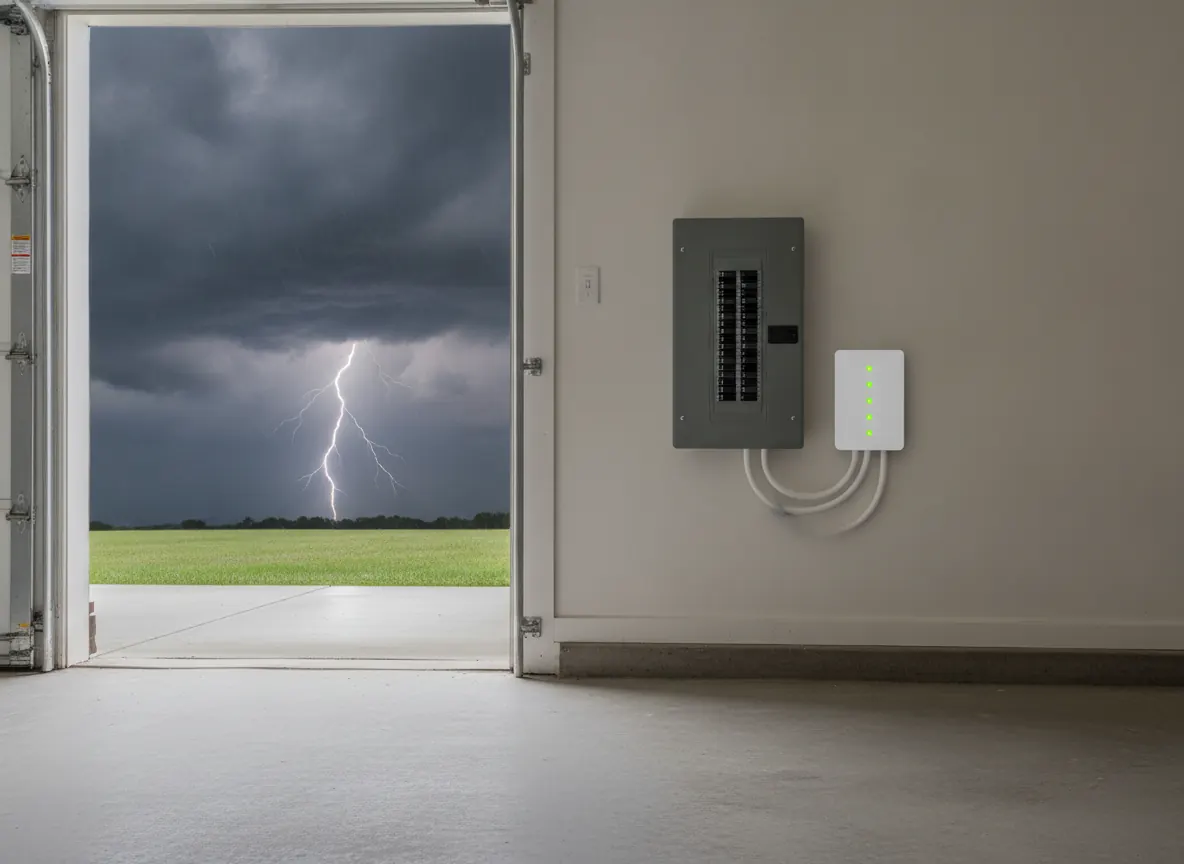
Short answer: a lightning strike nearby, not just on your house, can push a surge in through the power lines, cable, phone or antenna wiring. Damage is often quiet: a GFCI that won't reset, a dead garage door opener, a furnace or air conditioner control board, a TV or router. If you smell burning or see smoke, call 911 first, since lightning can start fires inside walls and attics. Otherwise, work through the checklist below and call a licensed electrician for anything at the panel, meter base or wiring.
Right after the storm: safety first
- Smoke, a burning smell, or heat in a wall or ceiling: get everyone out and call 911. Fire crews can check for hidden fire with thermal cameras.
- A line down or the service mast damaged: stay away and report it to Evergy on the Evergy outage map. Our weatherhead and meter base guide covers the repair.
- Power out: see whether it's the neighborhood or just you with our Evergy or electrician guide.
- Everything seems fine: still walk through the checklist below within a day or two, while the details are fresh for any insurance claim.
A walk-through checklist
- Open the panel door. Look for tripped breakers, scorch marks, a burnt smell or a warm cover. Don't remove the cover.
- Reset each GFCI outlet and GFCI breaker. One that won't reset may be damaged.
- Test smoke and carbon monoxide alarms.
- Check the furnace, air conditioner or heat pump, water heater, garage door opener, well pump and sump pump.
- Check electronics: TV, router, modem, computers, doorbell camera, smart thermostat.
- Look at outlets and switch plates for discoloration or warmth, and listen for buzzing.
- Walk outside and look at the meter base, mast and the grounding wire for burn marks.
- Notice any lights that flicker or dim since the storm.
- Write down what doesn't work and take photos.
Signs you need an electrician, not just a reset
- a breaker that trips again right after you reset it;
- scorch marks, melted insulation or a burning smell at any outlet, switch or the panel;
- several outlets or a whole room dead with no tripped breaker;
- lights that flicker or dim across the house;
- visible damage at the meter base, mast or grounding electrode;
- appliances that fail one after another.
Those can point to damaged conductors, a failed breaker or a loose neutral. Our emergency electrician page explains what to do while you wait.
What an electrician typically checks
- The service and panel: main and branch breakers, bus, lugs and the condition of the service conductors.
- Grounding and bonding: the grounding electrode, water pipe bond and the connections that give a surge a path to earth.
- Branch circuits: outlets, switches and GFCI/AFCI devices that failed.
- Surge protection: whether a whole-home surge protector is present and still working; most show a status light.
- A written report: a short description of the damage and an itemized quote, which helps with insurance.
Insurance
Many homeowners policies cover lightning damage, but terms vary. Call your insurer before major repairs if you can, and keep:
- photos of damaged equipment and any scorch marks;
- the date and time of the storm;
- the electrician's written description and itemized quote;
- receipts for replaced electronics and appliances.
Thunderstorm season in Topeka
Summer storms here often bring lightning, wind and outages together. On June 26, 2024, 12,901 Topeka customers were without power in 65 separate outages (WIBW). On July 31, 2024, thunderstorms caused about 13,000 outages in the Topeka area, per Evergy as reported by WIBW. When power drops and returns during a storm, the switching itself can stress electronics, so unplug sensitive equipment when a storm is close and wait a few minutes after power returns before plugging it back in. If you're unsure whether a problem started with the storm, note it anyway and mention it to the electrician.
Surge protection for next time
Lightning is common across the country. Vaisala's 2025 report counted 252 million lightning strikes in the U.S., an eight-year high. A whole-home surge protector mounted at the panel limits surges that come in on the power service. It works best paired with point-of-use surge strips for electronics, and with cable and phone lines bonded at the same grounding point.
No device stops a direct strike, and a whole-home unit doesn't protect cable or antenna lines unless they're grounded properly too. Recent editions of the National Electrical Code call for surge protection when a dwelling's service is installed or replaced. Topeka enforces the 2023 NEC, so ask your contractor whether that applies to your job. The whole-home surge protection page has more detail.
| Job | Typical range | Source |
|---|---|---|
| Service call (often covers the first hour) | $100–$200 · service visit $176–$327 | HomeGuide · Fixr |
| GFCI outlet | $130–$300 (avg ≈ $210) | Angi, 2026 |
| Whole-home surge protector | $200–$800 installed | HomeGuide · Angi |
| Panel replacement, same amperage | $518–$2,193 (avg ≈ $1,347) · $1,400–$2,800 | Angi · HomeGuide |
More ranges and a calculator are in the Topeka electrician cost guide.
Questions to ask before repairs
- What is your City of Topeka license number?
- Can you send insurance and workers' comp certificates?
- Can you put the damage and repairs in a written, itemized quote I can send my insurer?
- Is there a trip or diagnostic fee, and what is the after-hours rate?
- Who pulls the permit if the panel or service is replaced?
- Does the job need Evergy coordination?
Kansas has no statewide electrician license; cities and counties license electricians (K.S.A. 12-1525). In Topeka, ask for the contractor's City of Topeka license and confirm it with Development Services (785-368-3905); the city also posts a licensed-contractor list. In Lawrence, check with Lawrence Building Safety (785-832-7700). Outside city limits in Shawnee County, Land Use & Development (785-251-5410) handles permits. Ask for certificates of liability insurance and workers' comp.
One more Kansas rule: Kansas gives a 3-business-day right to cancel many door-to-door sales of $25 or more (K.S.A. 50-640), but a repair visit you requested can be excluded. Ask, and get it in writing.
About this site: Topeka Electricians is a free quote-referral service, not an electrician or electrical contractor. It holds no electrical license and does not perform electrical work. You describe the job once, and independent electrical contractors serving Topeka, KS and nearby towns can reply with quotes on their own schedules. Some companies may pay to receive requests or calls. Request free quotes.
Frequently asked questions
Can lightning damage wiring if nothing caught fire?
Yes. A nearby strike can send a surge through the power service or cable and phone lines, damaging GFCIs, breakers, appliance control boards and electronics with no visible fire. A licensed electrician can test the panel, grounding and circuits.
What should I check after lightning hits near my house?
Check for smoke or burning smells first and call 911 if you find any. Then look for tripped breakers, GFCIs that won't reset, dead appliances or electronics, warm or discolored outlets, and burn marks at the meter base.
Does homeowners insurance cover lightning damage?
Many policies do, but coverage varies. Photograph the damage, note the storm date, and get a written, itemized description from the electrician to send your insurer.
Will a whole-home surge protector stop lightning?
Not a direct strike. A panel-mounted surge protector limits surges that come in on the power service. Pair it with point-of-use strips and proper grounding of cable and phone lines.